What Software Engineering Viewers Actually Wanted This Week
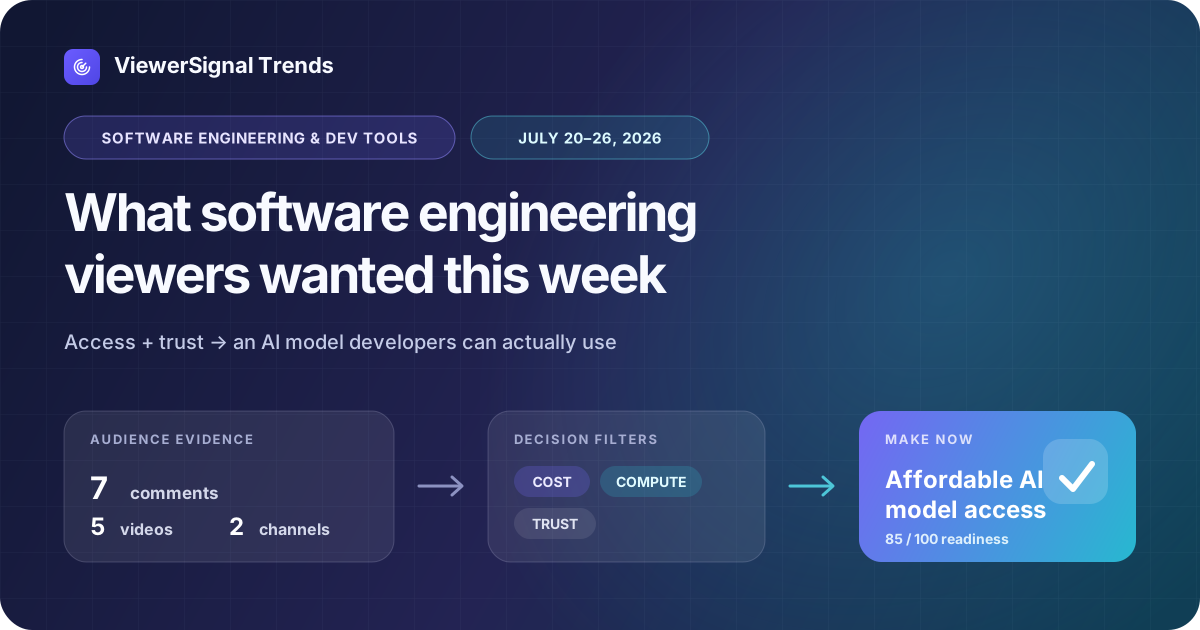
This week's software engineering comments were not asking whether AI belongs in development. Viewers were trying to work out which models they can afford and trust, where AI genuinely improves a workflow, and how to keep understanding and accountability when the tools move faster than the developer.
- Published:
- Coverage:
- July 20–26, 2026
This week in 30 seconds
- The clearest immediate opportunity is a practical guide to affordable AI model access that treats cost, infrastructure, open weights, and trust as one decision.
- Developers are already finding useful AI-assisted workflows, but they want concrete examples for testing, documentation, debugging, and internal tooling.
- Agent architecture has a sharp tutorial request, while code comprehension and accountability are becoming the conditions that make AI productivity advice believable.
Top content opportunity
The best AI model is irrelevant if developers cannot access or trust it
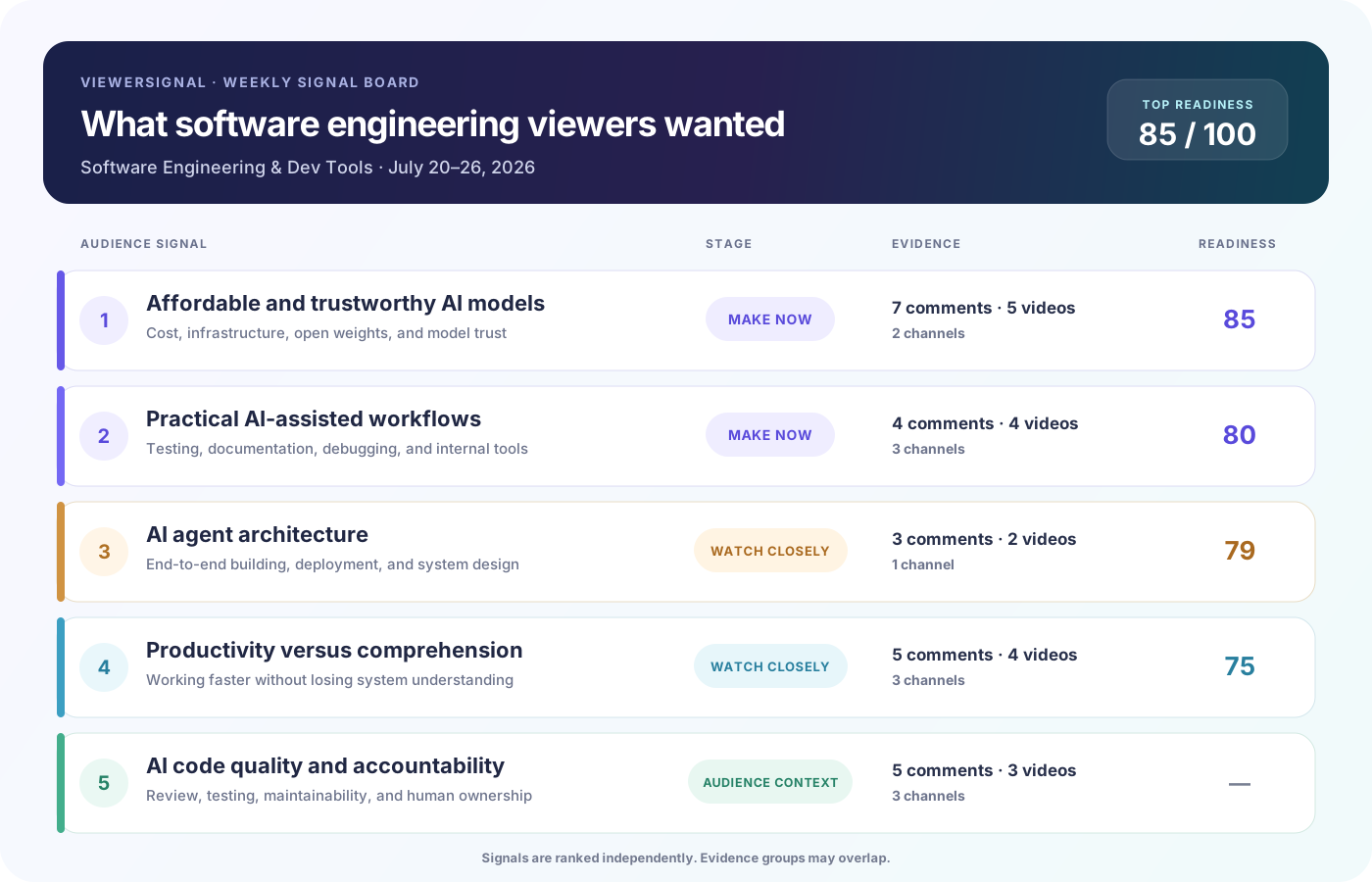
Seven related comments across five videos and two channels focused on AI model accessibility, cost, and trust, giving this Make Now signal an 85/100 readiness score. Viewers questioned whether advanced models are useful to ordinary developers when they require expensive infrastructure, restrictive access, or a level of trust they do not have.
The comments connect several parts of the same decision. One viewer challenged the value of open models that still demand major compute investment. Another objected to unequal access even when users are willing to pay. Trust in models associated with particular countries added a separate concern about where the technology comes from and what developers are comfortable running.
A useful video should compare realistic access paths rather than ranking models on benchmark performance alone. That means showing hosted subscriptions, API pricing, local or self-hosted requirements, open-weight tradeoffs, privacy considerations, and the point at which infrastructure cost changes the recommendation.
The evidence is concentrated in two channels, so the strongest framing is a developer decision guide, not a universal verdict on which model or country can be trusted.
Video angles supported by this signal
- The real cost of running the best open AI models
- Hosted, API, or local AI: which option should a developer choose?
- How to evaluate an AI model you do not fully trust
Second Make Now signal
Developers want AI workflows that solve a real production problem
Four related comments across four videos and three channels described practical AI tooling and workflow optimization, producing an 80/100 readiness score. The useful examples were not generic requests to code faster. Viewers described using AI to build debugging interfaces, generate small internal tools, explore a system, and reduce repetitive work around a production pipeline.
That distinction gives creators a stronger job than another list of coding assistants. The audience wants to see where an AI tool enters the workflow, what context it receives, what the developer still verifies, and how much time or reliability the change actually adds.
The source report points toward testing, documentation, debugging, and internal tooling as concrete angles. A strong demonstration should begin with one recurring bottleneck, show the before-and-after process, and include the failure modes or review step that keeps the result safe to use.
Video angles supported by this signal
- Build an AI-assisted debugging tool from a real production problem
- Automate software documentation without losing accuracy
- Three AI coding workflows that save time beyond autocomplete
Direct tutorial request
AI agent architecture is ready for a practical lesson, not a broad trend video
Three related comments across two videos requested practical instruction on building, deploying, and designing AI agents. The signal reached 79/100 readiness, but all of the evidence came from one channel, which is why the source report keeps it in Watch Closely.
The request itself is unusually clear. Viewers asked for an end-to-end agentic solution and for an agentic service architecture explained through system design. That suggests an audience beyond prompt experimentation: developers want to understand components, boundaries, deployment, observability, and how an agent fits into a larger application.
A creator can test the idea now with a narrow implementation, but should resist presenting one framework as the category-wide answer. The signal becomes much stronger if similar direct requests repeat across more channels.
Video angles supported by this signal
- Build and deploy your first AI agent service step by step
- AI agent system design: components, boundaries, and failure modes
- From local demo to production agent architecture
Productivity tension
AI can make developers faster than they can understand
Five related comments across four videos and three channels focused on balancing AI-driven productivity with code comprehension, giving the signal a 75/100 readiness score. Viewers described a gap between how quickly AI can produce an implementation and how quickly a developer can evaluate what it did.
The concern is not simply that AI-generated code may contain errors. It is that teams can reward visible output such as shipped features or lines changed while the developer loses the system understanding needed to maintain, debug, or defend that work later.
That makes comprehension part of the productivity calculation. A useful video could show when to slow down, which generated changes deserve a manual trace, how to use tests and architecture boundaries as evidence, and which metrics make AI-assisted work look faster without proving that it is better.
Video angles supported by this signal
- How to use AI coding tools without losing code comprehension
- The hidden maintenance cost of AI-assisted development
- A review checklist for code you generated faster than you can read
Supporting reliability signal
Productivity claims fail when nobody owns the code
A supporting audience-context cluster contained five related comments across three videos and three channels about AI code quality and accountability. This group did not receive an individual readiness score, but it makes the report's productivity signals easier to interpret.
Viewers pushed back on workflows that replace reading, testing, or existing engineering discipline with another layer of generated tooling. The common objection is not that AI can never produce serious software. It is that someone still has to verify correctness, understand the change, and remain accountable when a system fails.
Creators can address that trust blocker directly by showing the evidence behind an AI-assisted result: tests, code review, constraints, observability, rollback plans, and the human decision that accepted the change. Without that layer, a speed demonstration may answer the wrong question.
Video angles supported by this signal
- Who is accountable when AI-generated code breaks production?
- The code review process every AI-assisted team needs
- How to prove AI-generated code is ready to ship
Why this matters
The common thread is leverage without losing control. Developers are open to models, agents, and workflow automation when the access is realistic and the engineering remains understandable. Software creators can earn trust by showing costs, constraints, verification, and ownership alongside the impressive part of the demo.